


- Written by: unitedadmin
- May 16, 2024
- Categories: Blog, Education
- Tags:
In short: Play-based learning is a way of teaching young children through play. Children explore, build and pretend while a teacher guides them. Along the way, they pick up language, numbers, social skills and self-control. It is the main teaching style in many preschools for children aged 18 months to 6 years.
Many Nepali parents feel a little worried when a preschool says “our children learn through play.” It sounds like the children are not studying. But that is not the case. Good play is hard work for a small child. At this age, it is how the brain learns best.
This guide explains play-based learning in simple words. You will see the types of play, the benefits, examples for each age and easy ideas you can try at home.
Play-Based Learning Explained
Play-based learning refers to the way of teaching children to learn by doing the things, not by sitting and copying. The teacher plans the space and the activities. Then the child leads the play, asks questions and tries things out.
For now, take an assumption of a shop. One child is the shopkeeper. Another is the customer. They count coins, name vegetables, and wait for their turn. At last, they even say “thank you”, that nobody guides it. Still, they practise maths, language and manners in just 5-10 minutes.
Learning Through Play vs Just Playing
Not all play is planned learning. At a party, children play when running around. That’s good as well. Play-based learning is unique in that it has a purpose. The teacher selects toys, arranges corner and closely observes. She poses minor questions such as “How many apples do you have now?” This is how it becomes learning when there are small questions like this.
Types of Play in Early Childhood
Teachers usually mix three types of play during the school day.
1. Free Play
The child chooses what to do and how to do it. It may be blocks, sand, dolls or drawing. Free play builds creativity and confidence. It also teaches children to make their own choices.
2. Guided Play
The teacher arranges an activity containing a learning goal and the child still leads. She puts cups of various sizes in a water tray and asks them which is the largest. Most early maths and science is dealt with here.
3. Structured Play
The teacher leads with clear rules and steps. Musical chairs, a rhyme with actions or a simple board game are good examples. Structured play teaches children to listen, take turns and follow instructions.
Children also move through social stages of play as they grow. Toddlers often play alone or next to other children without joining in. By age 4 or 5, most children play together and share ideas. Some even make up their own rules. Researcher Mildred Parten described these stages in 1932, and they are still widely taught to early childhood teachers.
Benefits of Play-Based Learning
Play supports every part of a young child’s growth. The Early Years Foundation Stage (EYFS) framework divides early learning into seven areas. Here is how play builds each one.
| EYFS learning area | What children learn | Play example |
| Communication and Language | Speaking, listening, new words | Puppet shows, storytelling, pretend phone calls |
| Physical Development | Balance, hand control, strength | Climbing, threading beads, playdough |
| Personal, Social and Emotional Development | Sharing, patience, handling feelings | Group games, role play, tidy-up time |
| Literacy | Sounds, letters, love of books | Rhymes, picture books, drawing letters in sand |
| Mathematics | Counting, shapes, size, patterns | Building blocks, sorting buttons, pretend shop |
| Understanding the World | Nature, people, how things work | Planting seeds, water play, festival activities |
| Expressive Arts and Design | Creativity, music, imagination | Painting, dancing, dress-up, crafts |
Children who learn through play also tend to enjoy learning more. They ask more questions. When something fails, they try again. That curious habit stays with them long after preschool.
Read more about the benefits of preschool education for Nepali children.
Play-Based Learning vs Traditional Worksheet Teaching
Some schools in Nepal still start small children on writing drills and homework. Here is how the two approaches compare.
Play-based learning | Traditional worksheet teaching | |
Who leads | Child leads, teacher guides | Teacher leads, child follows |
How children learn | Doing, touching, talking, exploring | Copying, repeating, memorising |
Pace | Each child at their own pace | Whole class at one pace |
Skills built | Thinking, social, language, motor and early academics | Mainly letters and numbers |
Mistakes | A normal part of learning | Often marked wrong |
How the child feels | Curious and confident | Can feel pressure or boredom |
This does not mean worksheets are always bad. In the last preschool year, short and fun pen-and-paper tasks can help. The problem starts when drills replace play for very young children.
Play-Based Learning Activities by Age
Playing behavior changes as children grow. Below is what it looks like at each stage of preschool.
Play Activities for Play Group (18 Months and Above)
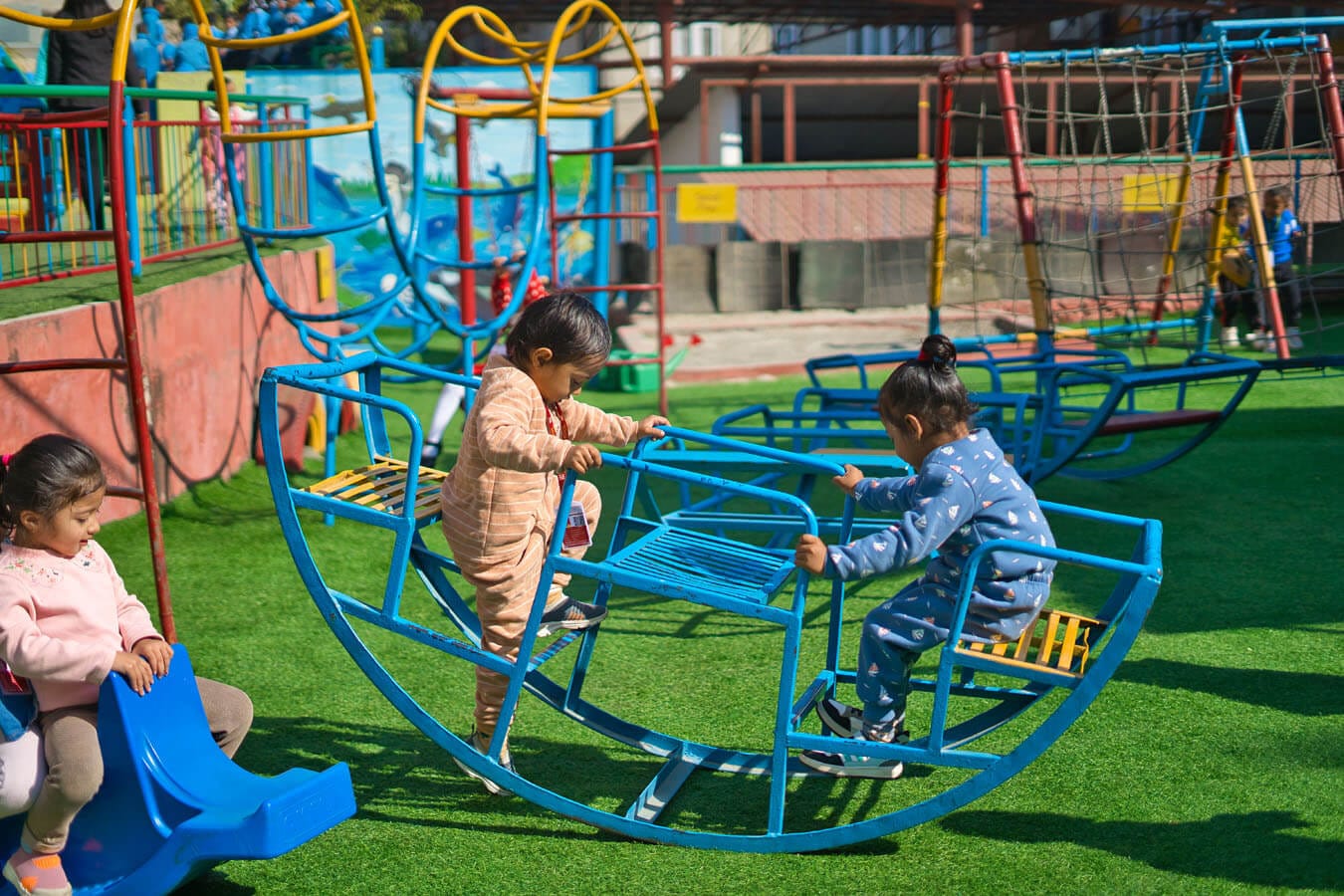
At this stage, play is mostly about the senses and the body. Children stack cups, push toys, splash water and dig in sand. They also listen to simple rhymes. They learn new words, gain hand control and get used to being around other children.
See more about our Play Group Program.
Play Activities for Nursery (3 Years and Above)
Children begin pretend play and simple group games. A play kitchen, a doctor’s kit and building blocks become favourites. They learn colours, shapes and counting to ten. They also learn how to wait for their turn.
Explore our Nursery program.
Play Activities for Junior Kindergarten (4 Years and Above)
Play becomes more planned and theme-based. For example, during a theme like “Things Around Us,” children sort pictures of living and non-living things. They copy animal sounds and look for insects in the garden. They also start linking sounds with letters.
Explore more on Junior Kindergarten.
Play Activities for Senior Kindergarten (5 Years and Above)
Children now play longer games with rules, solve puzzles and work in small teams. Teachers add more early reading, writing and number work, but still through games and hands-on tasks. This is the year that prepares children for Grade 1.
Learn more about Senior Kindergarten.
Getting Ready for Grade 1 Through Play
The biggest worry parents share is simple. “If my child plays all day, will they read and write on time?”
Yes, as long as the play is well planned. Children need strong basics before they can read and write well. They need strong hand muscles to hold a pencil. They need to hear the sounds inside words. And they need to sit, listen and follow steps. Play builds all of these.
6 early childhood teachers from four community schools in the Gandaki Province were interviewed in a small study in 2024 conducted by Kathmandu University. It found that these teachers saw play and learning as two separate things. The teachers were advised to use the activities suggested in the early childhood curriculum of Nepal but they did not do so regularly. The study correlated this with inadequate training and support. (Kathmandu University, 2024)
So the real choice is not “play or study.” It is whether the teachers know how to turn play into learning.
Play-Based Learning in Nepal
Play is not a foreign idea for Nepal. Our grandparents learned through folk stories, rhymes, festivals and outdoor games. Today, the Government of Nepal also supports learning through play in its Early Childhood Education and Development (ECED) program.
In 2025, UNICEF Nepal shared the story of one such program in Narayan Municipality, Dailekh. The government leads it and the European Union co-funds it. UNICEF gives technical support. Teachers received ECED training and play materials. In the ECED centres featured in the story, enrolment more than doubled in one year, from 564 to 1,151 children. (UNICEF Nepal, 2025)
More schools and families in Nepal now treat play as a serious part of early education.
A Typical Day in a Play-Based Preschool
Every school plans its own timetable. Still, most play-based preschools follow a similar rhythm.
- Arrival and free play. Children settle in with blocks, books or puzzles.
- Circle time. The class sings, talks about the day and shares small news.
- Theme activity. A guided activity linked to the week’s theme.
- Outdoor play. Running, climbing, sand play and nature walks.
- Snack and rest. Children practise washing their hands and eating on their own.
- Story, music or art. A calm, creative session.
- Tidy-up and goodbye. Children help pack away and talk about what they did.
This mix of active and quiet time keeps children busy without tiring them out.
Play-Based Learning at United Pre-School
United Pre-School in Satdobato, Lalitpur, teaches children aged 18 months to 6 years. It is part of United Academy Group, which has been working in education in Nepal since 1997.
Our teaching follows the EYFS framework. We blend Montessori and Kindergarten methods in a thematic, activity-based plan. English is the main language of teaching. In the early stages, we also use the child’s mother tongue, so no child feels lost.
Meet Our Qualified Preschool Teachers in Lalitpur United Preschool
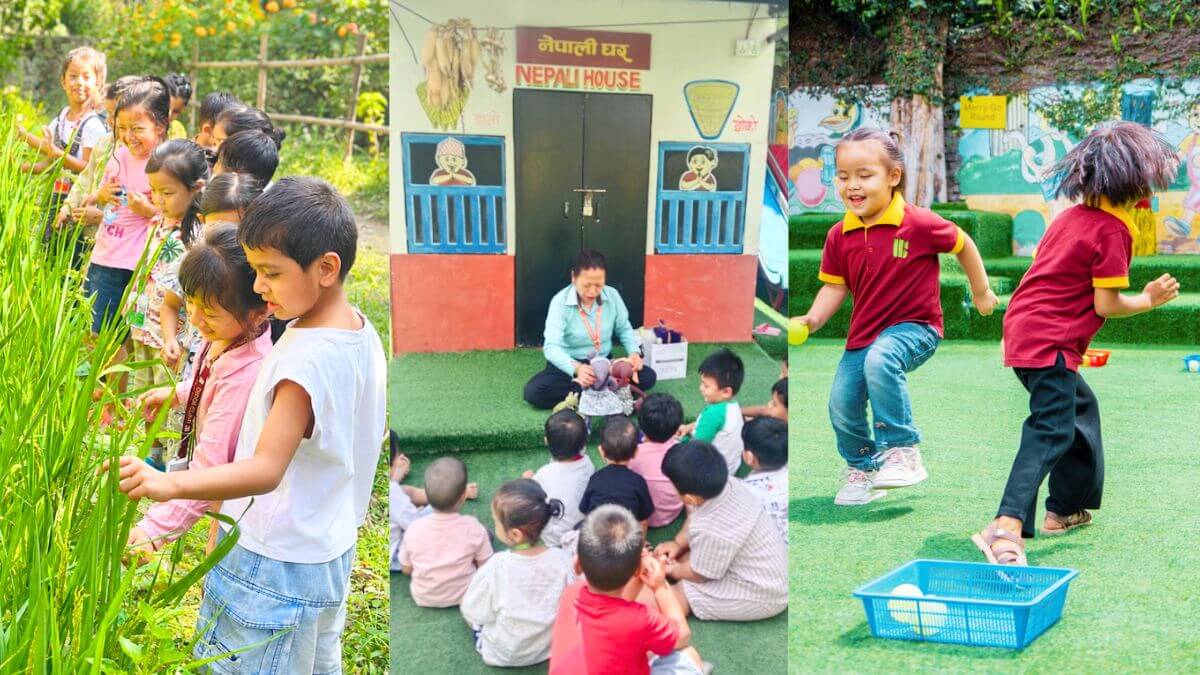
Play runs through the whole school day:
- Co-curricular activities like science corners, puppet shows, storytelling, spelling bees and cultural events.
- Extra-curricular activities like art, drama, cooking, music, yoga and swimming.
- Special events like field trips, workshops, festival celebrations and parent days.
Teachers watch each child during play and note how they are growing. We also run parent workshops, so families can use the same ideas at home. School runs from 9:00 AM to 3:00 PM in summer and from 9:05 AM to 2:45 PM in winter.
Recommended Read on: Extracurricular Activities in Kathmandu for Kids: A Parent’s Guide
Benefits of Play-Based Learning:
Boosts Cognitive Skills:
Activities like puzzles, blocks, and role-play help children think critically, solve problems, and make decisions.Enhances Social & Emotional Growth:
When children play together, they learn how to share, communicate, express feelings, and cooperate.Improves Motor Skills:
Outdoor play, drawing, cutting, and craft activities help develop both fine and gross motor skills.Encourages Creativity:
Open-ended play inspires imagination and teaches children to express ideas in unique ways.
How United Pre-School Implements Play-Based Learning:
Classrooms are designed with learning corners such as art, blocks, sensory play, reading, and dramatic play.
Teachers create meaningful play invitations that spark curiosity.
Play is balanced between structured activities and free exploration.
Outdoor playtime encourages physical activity and connection with nature.
Play-Based Learning Activities at Home
You do not need expensive toys. Simple daily moments work well.
- Kitchen helper: Let your child wash vegetables, count potatoes or roll roti dough. It builds counting skills and hand strength.
- Story time in your own language: Tell folk stories and ask, “What do you think happens next?” This grows imagination and language.
- Bagh-Chal: This traditional tigers-and-goats board game teaches counting, planning and patience. It suits children aged 5 and above.
- Sorting game: Mix spoons, buttons or leaves. Then ask your child to sort them by size or colour.
- Rhymes with actions: Nepali and English rhymes with hand movements build memory and rhythm.
- Nature walk: Collect stones, leaves and flowers on the way. Talk about their colours and shapes.
Keep screen time short. At this age, real objects and real conversations teach far more than a screen.
See Play-Based Learning in Action
Play-based learning allows children to grow holistically. At United Pre-School, our goal is to nurture happy, confident, and curious learners who are ready to take on the world,one joyful play moment at a time.
The best way to understand play-based learning is to see it for yourself. Book a school visit and watch a class at work. Admissions for 2083 are now open.
Apply for Admission | Also read: How to Choose the Right Preschool in Nepal
Common Questions From Parents
Is play-based learning effective?
Play-based learning is effective because it builds language, thinking, social and motor skills at the same time. Children stay interested for longer when they learn through play. They also grow to enjoy learning, and that positive habit helps them settle into formal school later.
Will my child learn to read and write?
Your child will learn to read and write, as play builds the skills these depend on. Hand control, listening and sound awareness all develop through games, rhymes and hands-on tasks. In Senior KG, teachers add more letter and number work, still through play.
Montessori or play-based learning: which is better?
Neither method is better for every child, as both are child-centred and hands-on. Montessori uses special learning materials and more independent work. Play-based learning uses more pretend play and group play. United Pre-School blends both methods to suit each child.
How do teachers track progress in a play-based class?
Children are closely monitored by teachers during play and the skills that are observed are documented. They report their progress to parents on a regular basis. It is about letters and numbers, but also about language, social skills, emotions and physical growth.
At what age can my child start?
Children can join Play Group at United Pre-School from 18 months. The right time still depends on your child. A good sign of readiness is when they can spend a few hours away from you without too much stress.